
Outcome verification
Flush Provably Fair Games 2026
Flush Originals include titles such as Plinko, Dice, Crash, Mines, Limbo, Keno, Hilo, Coin Flip and Wheel, and the Originals line uses a provably fair model. That label is useful only when its limits are clear: cryptographic verification can help show that a recorded outcome matches committed inputs, but it does not establish a favorable RTP, remove house edge, or guarantee that a player will win.
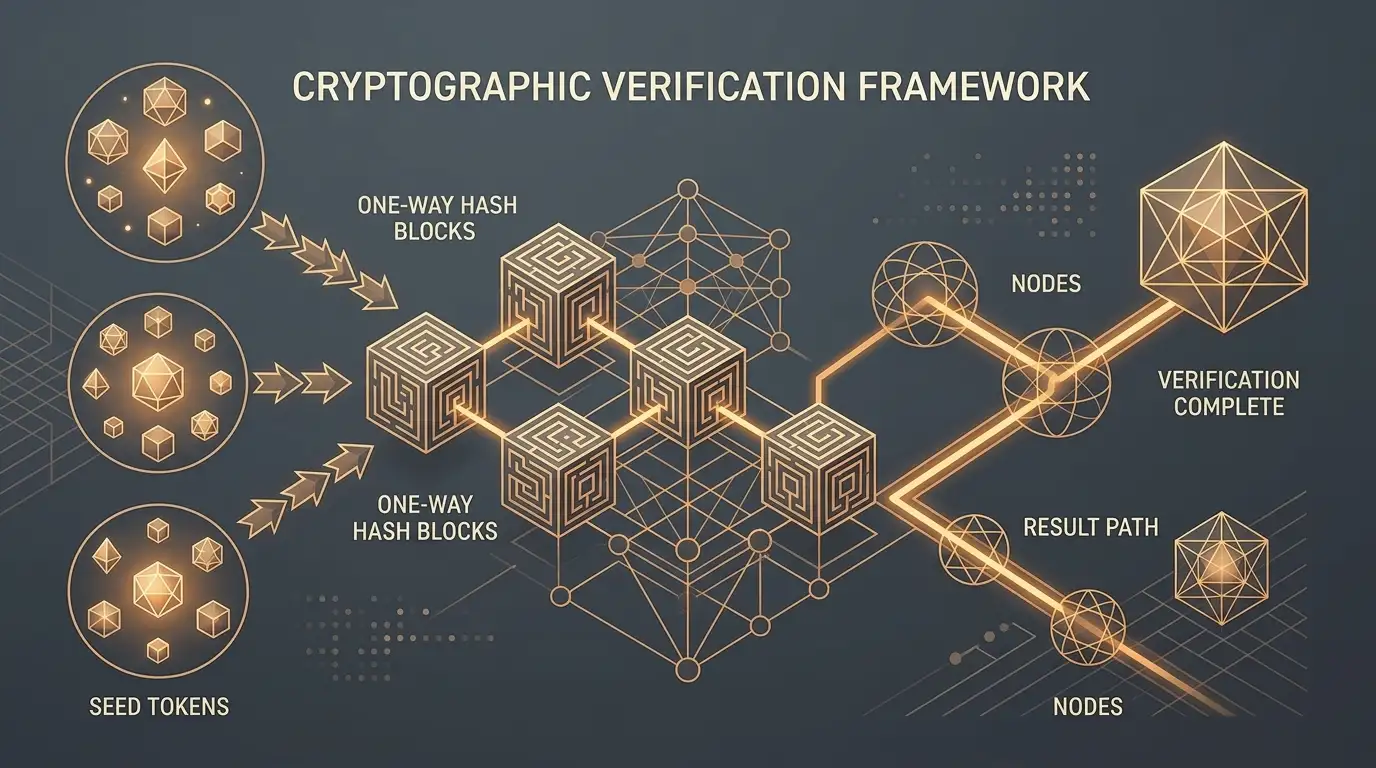
Provably fair is an audit trail for game outcomes
In a typical provably fair design, the game commits to hidden information before the wager is resolved. A server seed may be hidden behind a cryptographic hash, while a client seed gives the player-side input and a nonce or round counter separates one wager from the next. After the round, the original seed can be revealed and the result can be recalculated. If the revealed value produces the same commitment and the same outcome, the player has evidence that the committed inputs were not silently replaced after the bet.
That mechanism addresses a narrow but important question: did the game follow the committed result-generation process for this round? It does not answer whether the paytable is generous, whether the mathematical expectation favors the player, or whether a rapid series of bets is sensible for a given budget.
Server seed
A value controlled by the game side. In common implementations it is committed in hashed form before the result is revealed.
Client seed
A second input associated with the player or session. It can help prevent the game from being the sole source of result input.
Hash
A one-way cryptographic commitment. Matching the later-revealed seed to the earlier hash is one part of checking that the committed value did not change.
Nonce
A round counter or similar value that lets the same seeds produce distinct results across consecutive wagers.
Flush has a distinct Originals catalog. The provably fair label applies to that in-house context; it should not be assumed to describe every third-party game in the wider Flush games library.
A proper check follows the commitment from seed to result
The exact interface can differ between games, but the verification logic is usually recognizable. The point is to reproduce the chain rather than trust a badge or label by itself.
- Record the pre-round commitment, usually a hash of the server seed or an equivalent cryptographic value.
- Identify the client-side input and the round-specific nonce or counter used for the wager.
- After the result is settled, obtain the revealed server seed for the completed sequence.
- Hash the revealed server seed and compare it with the commitment shown before the wager. The values should correspond exactly.
- Use the game’s published result formula or verification method to combine the inputs and reproduce the recorded outcome.
- If the recomputed result differs, stop and investigate before treating the mechanism as successfully checked.
Commitment check
Confirms that the revealed server value matches the earlier cryptographic commitment.
Outcome check
Confirms that the published calculation maps the seeds and round input to the result shown.
What must stay separate
Fairness of the result-generation process and attractiveness of the game’s expected return are different questions.
Use the verification controls presented by the game itself. A fairness check is meaningful only when the inputs, commitment and calculation all belong to the same completed round.
A valid proof does not establish RTP, house edge or low risk
Cryptographic verification can be technically correct while the game remains mathematically unfavorable to the player. A provably fair system proves consistency between committed inputs and a result formula; it does not rewrite the paytable. If a game pays less in expectation than it takes in wagers, that economic structure can coexist with perfectly verifiable outcomes.
The same distinction applies to volatility. Two games can use transparent result generation but produce very different session paths. A low-frequency large payout structure can create long losing stretches, while a fast simple game can turn over many wagers quickly. Neither behavior is captured merely by seeing that a seed hash matches.
What verification can establish
- The revealed seed matches the earlier commitment.
- The published calculation reproduces the recorded result.
- The round can be independently rechecked after settlement.
What it does not establish
- A specific RTP or house-edge value unless the game publishes one.
- That the game is profitable for the player.
- That a winning streak or losing streak will continue.
- That rapid repeated betting is financially low risk.
Flush Originals give the concept a concrete game context
Flush lists an in-house studio with games including Plinko, Dice, Mines, Limbo, Crash, Keno, Hilo, Coin Flip, Wheel, Blackjack, Baccarat, Roulette, Craps, Video Poker and Dragon’s Tower. The provably fair model applies to the Originals line. That makes these titles the natural place to look for seed, hash or verification controls inside the Flush casino product.
The catalog itself spans different interaction patterns. Dice, Limbo and Coin Flip are compact probability games; Mines and Plinko use staged or path-like outcomes; Crash adds an exit-timing decision; table-style originals adapt familiar casino formats into software. The cryptographic principle can remain similar while the player-facing mechanics differ substantially.
This matters because verification should be attached to the actual game process you are playing. Do not assume that understanding one original automatically explains another title’s rules or payout mechanics. Read the game instructions first, then use the fairness controls as a second layer of inspection.
A worked verification pattern shows where errors usually happen
Imagine a completed round where the game showed a hashed commitment before play, then later revealed the underlying server seed. The first check is mechanical: hash the revealed seed with the specified algorithm and compare the output character for character with the earlier commitment. A single different character means the commitment check has failed; a visual resemblance is not enough.
The second check uses the client seed and round counter together with the revealed server seed. The game’s published transformation should reproduce the raw result used for that round. This is where a common mistake occurs: checking the hash correctly but then using the wrong nonce, the wrong client seed, or a formula from another game. A valid server-seed commitment does not automatically validate a result calculation performed with mismatched inputs.
The third check maps the raw cryptographic output into the game result. Different game types can convert the same style of hash output into very different events: a dice roll, a crash multiplier, a Plinko path or a mine placement. That mapping must be part of the published game logic. If the mapping is opaque, the player can check the seed commitment but cannot independently reproduce the whole result chain.
Keep a small verification record when testing the feature: the pre-round commitment, client seed, nonce, revealed seed and final result. You do not need to save every wager forever; checking several rounds after seed rotation is enough to understand whether the mechanism is transparent and reproducible in practice.
Check the proof and the betting mechanics separately
- Confirm the game actually exposes seed, hash or verification information before relying on the provably fair label.
- Save or note the pre-round commitment if you plan to reproduce the result later.
- Check that the revealed seed matches the earlier hash exactly.
- Use the stated calculation method rather than an unrelated third-party formula.
- Read the game’s wagering rules independently of the fairness proof.
- Set a session budget and time limit before fast repeated rounds make the process feel mechanical.
Identity checks and account access are separate from game verification. For the onboarding model, use the Flush account guide; a provably fair result does not imply anything about account-verification requirements.
Questions about Flush provably fair games
Are Flush Originals provably fair?
Flush Originals use a provably fair model. Flush also operates a named in-house Originals catalog that includes Plinko, Dice, Crash, Mines, Limbo, Keno, Hilo, Coin Flip and Wheel among other titles.
Does provably fair mean Flush Originals have favorable odds?
No. Provably fair concerns whether an outcome can be checked against committed cryptographic inputs. It does not establish a favorable RTP or house edge.
Why does the nonce matter in a provably fair check?
The nonce separates consecutive rounds that use the same seed pair. Using the wrong round counter can produce a different result even when the server and client seeds are correct.
What should I verify after a round?
Check that the revealed server seed matches the earlier cryptographic commitment and that the published calculation reproduces the recorded result from the relevant seed and round inputs.
Read next
Cryptographic transparency is useful when you know exactly what it proves
Flush Originals provide a clear context for provably fair mechanics, but the practical value comes from doing the verification rather than trusting a label. Match the revealed seed to its commitment, reproduce the outcome where the interface allows it, and keep that technical check separate from questions about RTP, session pace and how much you are willing to risk.
Written by the editors at Flush.